TRIGGERZ® TRANSFORMATION SYSTEM
FOR SCHOOLS, YOUTH PROGRAMS, FAMILIES, LEADERS, ADULTS IN CRISIS, AND COMMUNITY SPACES
TRIGGERZ® is a neuroscience‑informed nervous system regulation methodology that guides people from trigger to transformation through emotional processing, physiological regulation, and truth‑based identity renewal. Built on the 13 Pillars of Truth, the 8‑Step System, and the 11s Sequence, it turns emotional activation into a clear, repeatable pathway toward safety, coherence, and lasting inner change.
TRIGGERZ® helps people recognize emotional activation in real time, regulate the body, and move through pain with awareness, presence, and truth. Instead of treating emotion as something to escape, the system teaches participants to experience emotion as information, process it safely, and integrate it into wiser beliefs, healthier behaviors, and a more grounded sense of self.
WHY TRIGGERZ® MATTERS NOW

CDC says youth in the United States are experiencing a mental health crisis, and schools can play a powerful role in reversing these trends by helping students feel connected, supported, and safe. In daily life, chronic stress and disconnection often show up as conflict, numbness, impulsivity, overthinking, shutdown, fractured identity, and difficulty sustaining healthy choices under pressure. TRIGGERZ® meets this reality with a somatic and spiritual framework that works at the level of nervous‑system state, story, and self‑organization.
40%
3 weeks
1 in 7
About 40% of U.S. high school students reported persistent feelings of sadness or hopelessness in recent national data summarized by NAMI.
1 in 7
3 weeks
1 in 7
More than 1 in 7 U.S. youth ages 6–17 experience a mental health disorder.
3 weeks
3 weeks
3 weeks
A 2025 randomized controlled trial, ‘Smartphone screen time reduction improves mental health,’ found that reducing smartphone screen time for three weeks improved depressive symptoms, stress, sleep quality, and well‑being, supporting concern about digital overload as a real mental‑health factor
WHAT IS the TRIGGERZ® transformation system?
TRIGGERZ® is a somatic transformation system designed to retrain patterns between beliefs, emotions, nervous‑system states, and behaviors through direct experience. It teaches people to feel to heal, using the body as the doorway to awareness, regulation, integration, and identity shift.
architecture
baseline principle
.png/:/rs=w:1240,cg:true,m)
transformation
evidence
imprisonment to empowerment
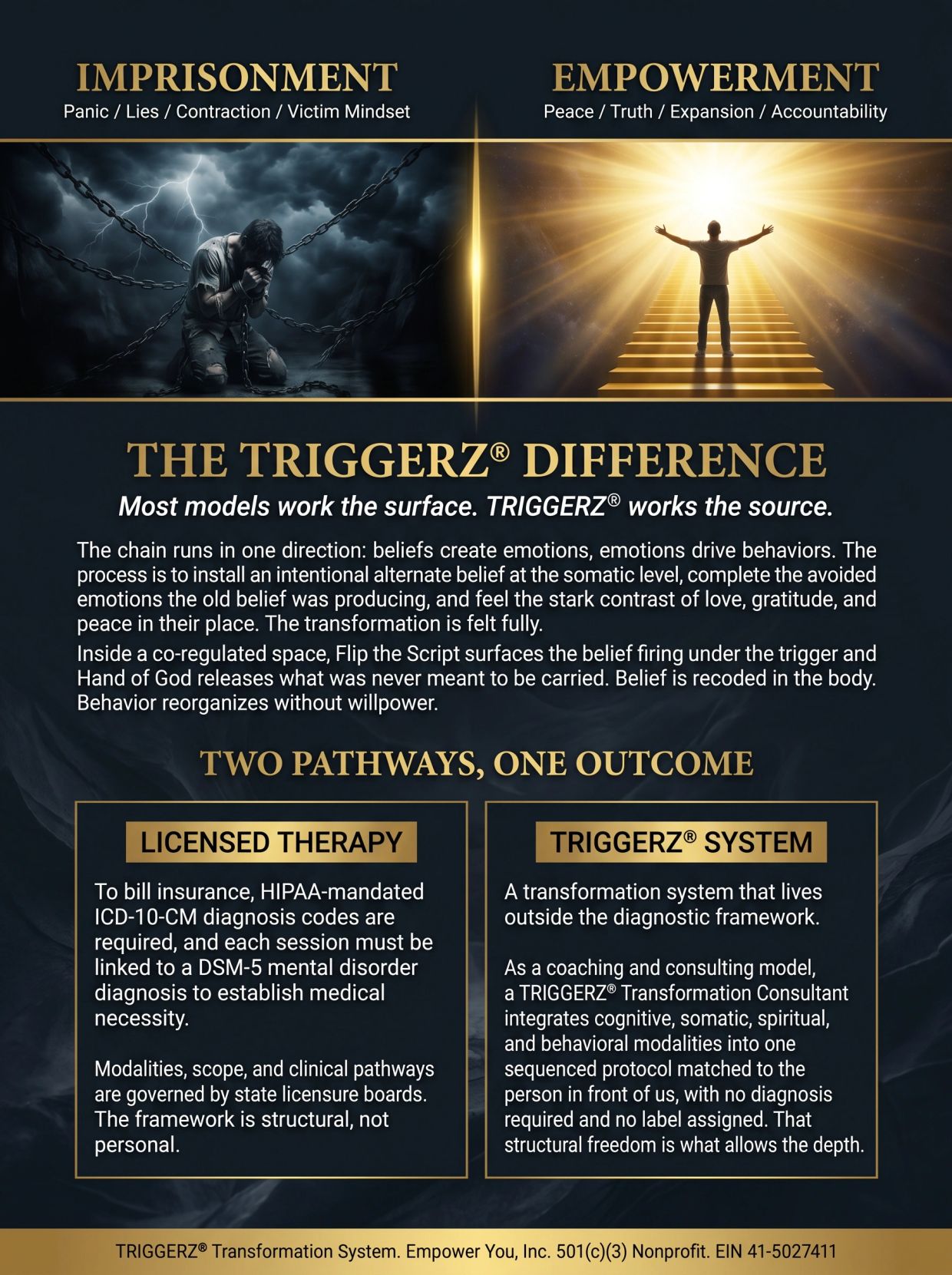
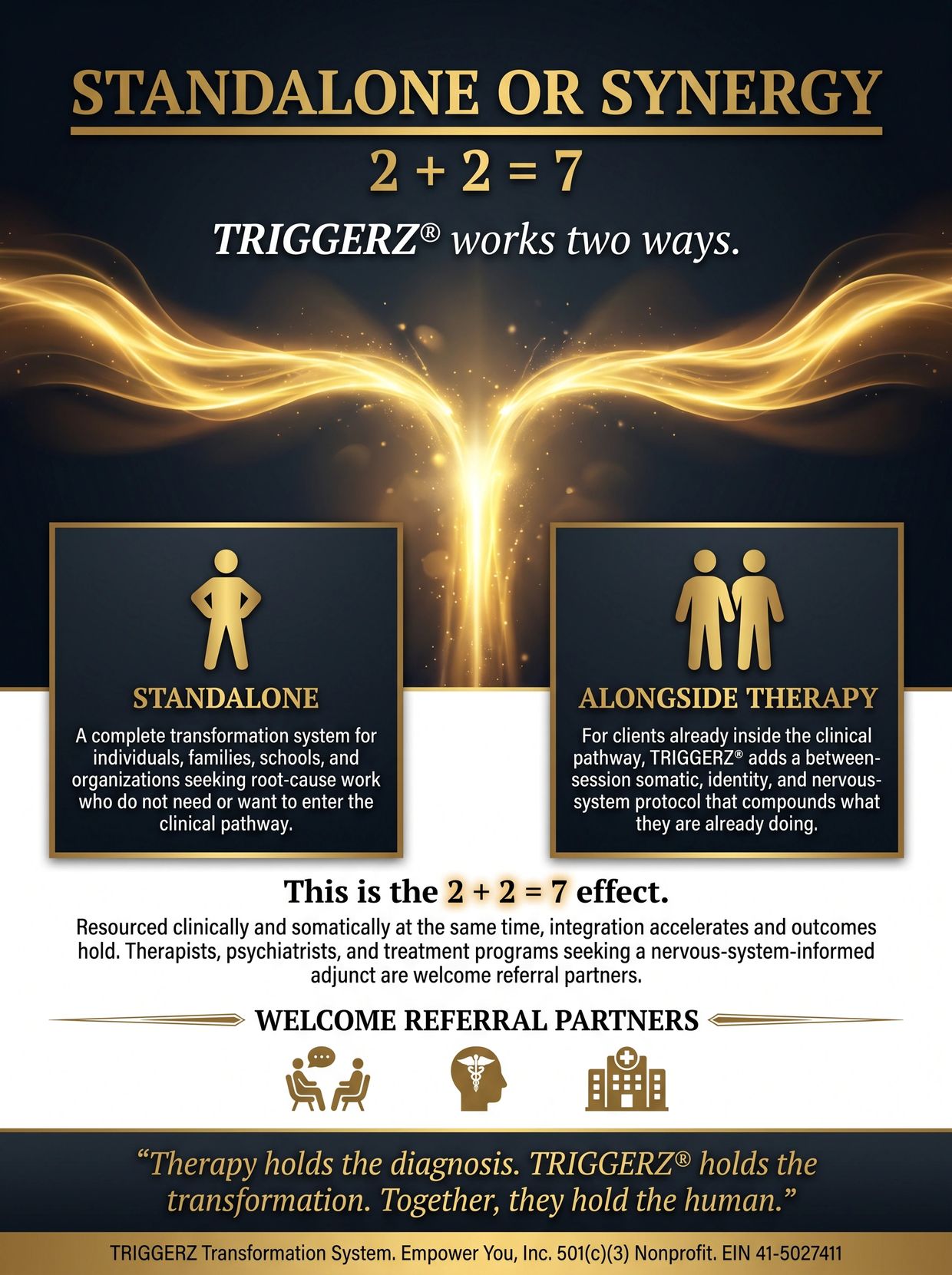
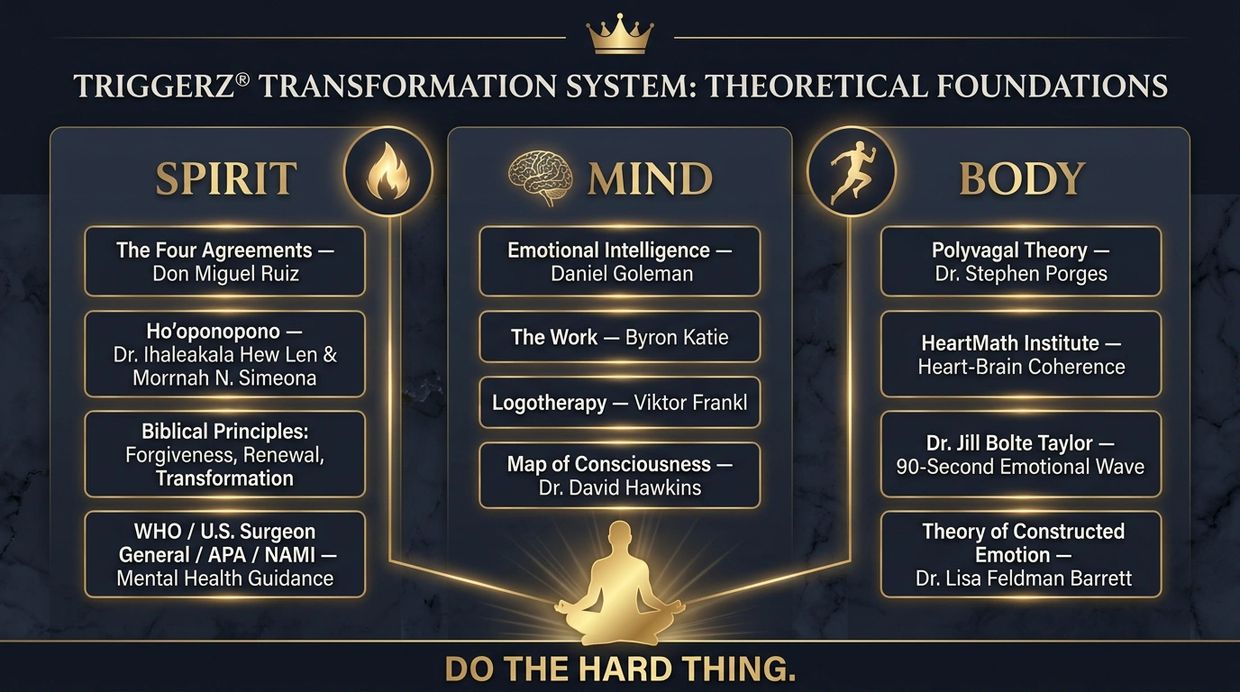
Developed in 2021 by Britney Valas, TRIGGERZ® has been continuously refined through lived experience, somatic practice, observation, and pattern recognition, integrating neuroscience‑informed regulation tools, experiential transformation frameworks, and spiritual truth. Drawing on research in embodied cognition, interoception, and nervous‑system science, the system is rooted in the understanding that the deepest learning is embodied. That calming the nervous system and fully engaging the felt experience opens the prefrontal cortex for reflection, perspective, and new choice in ways information alone cannot. Because it is sequenced somatically first and cognitively second, TRIGGERZ® remains deliberately responsive and innovative, able to incorporate emerging research, spiritually grounded insight, and real‑world feedback from youth and adults in crisis to help people move from survival responses into truth, regulation, sovereignty, and peace.
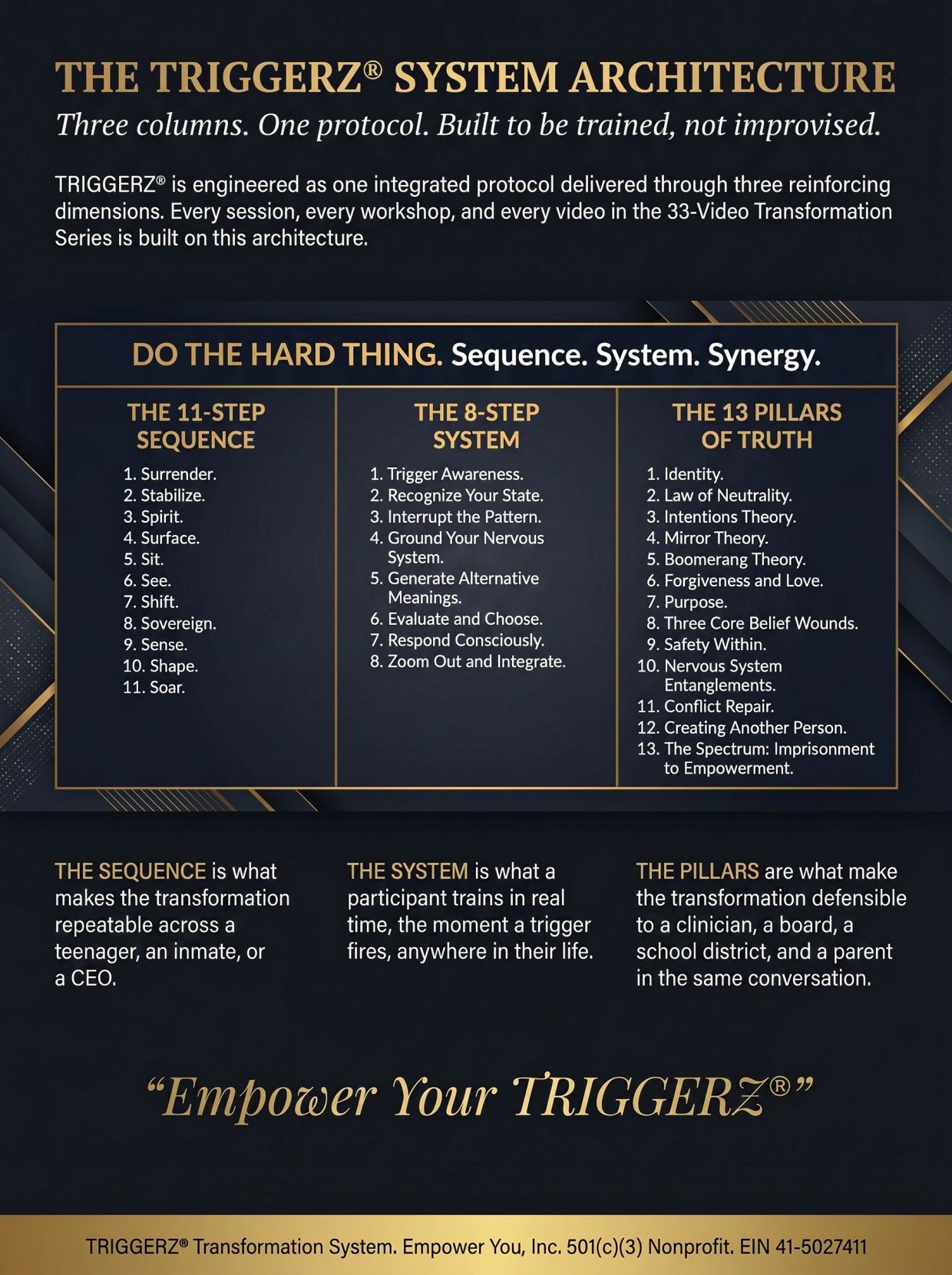
Under the surface, TRIGGERZ® is held by three integrated structures that work together to guide participants from activation to embodied change.

Surrender, Stabilize, Spirit, Surface, Sit, See, Shift, Sovereign, Sense, Shape, and Soar describe the internal somatic and spiritual progression from noise and fragmentation into truth, embodiment, identity, aligned behavior, and lived reality.
- Surrender – Quiet the noise.
- Stabilize – Calm the body.
- Spirit – Connect with God.
- Surface – Let feelings rise.
- Sit – Stay with the feeling.
- See – 'Flip the Script' & 'Hand of God' Tools.
- Shift – Feel the new belief.
- Sovereign – Stand in your identity.
- Sense – Feel the new baseline.
- Shape – Let behavior follow.
- Soar – Live the transformed reality.
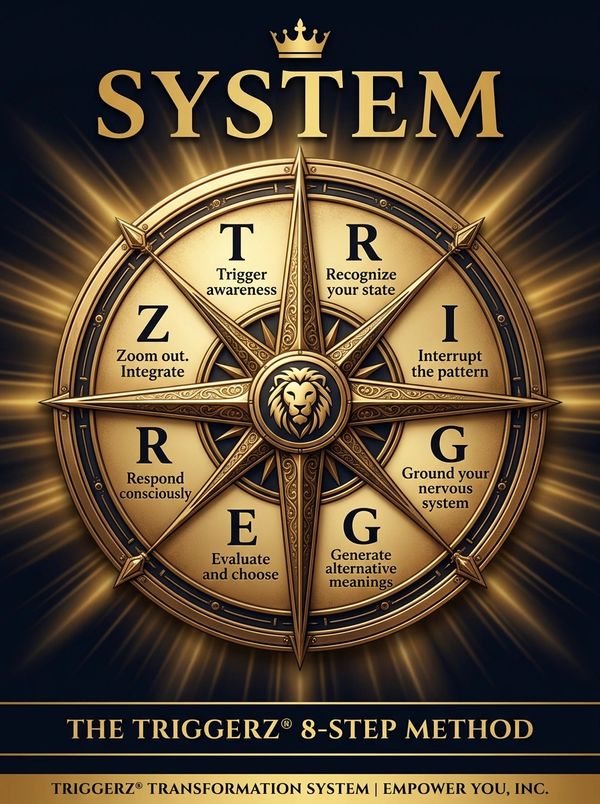
Trigger awareness, Recognize your state, Interrupt the pattern, Ground your nervous system, Generate and feel into alternative meanings, Evaluate and choose, Respond consciously, and Zoom out to integrate.
This is the method participants can practice in real time whenever activation hits.
- T – Trigger Awareness: Observe your patterns with the TRIGGERZ® Transformation App.
- R – Recognize Your State: Locate yourself on the emotional map.
- I – Interrupt the Pattern: Use go‑to phrases and tools to pause the autopilot.
- G – Ground Your Nervous System: Practice daily regulation and build internal safety.
- G – Generate Alternative Meanings: Use Flip the Script & Hand of God to feel new truths.
- E – Evaluate & Choose: Let peace and panic reveal which belief is real.
- R – Respond Consciously: Act from the new, coherent baseline.
- Z – Zoom Out & Integrate: Let the shift stabilize so behavior reshapes itself.
.png/:/cr=t:0%25,l:0%25,w:100%25,h:100%25/rs=w:600,cg:true)
The 13 pillars form the foundation of TRIGGERZ®'s interpretive framework, addressing identity, neutrality, intention, reflection, forgiveness, purpose, wounds, safety, nervous‑system entanglements, conflict repair, creation, and the spectrum from imprisonment to empowerment. They reshape how participants understand themselves and others, their stories, and their choices.
- Pillar 1 – Identity & Reality.
- Pillar 2 – Law of Neutrality.
- Pillar 3 – Intentions.
- Pillar 4 – Mirror.
- Pillar 5 – Boomerang.
- Pillar 6 – Forgiveness & Love.
- Pillar 7 – Purpose & Design.
- Pillar 8 – Core Wounds.
- Pillar 9 – Safety Within.
- Pillar 10 – Nervous System Entanglements.
- Pillar 11 – Conflict Repair & Communication.
- Pillar 12 – Co‑Creation.
- Pillar 13 – The Spectrum: Imprisonment → Empowerment.
TRIGGERZ® 8-STEP SYSTEM, EXPANDED
T – Trigger Awareness – Observe With the TRIGGERZ® App
R – Recognize Your State – Learn Where You Are on The Emotional Map
R – Recognize Your State – Learn Where You Are on The Emotional Map
Begin in partnership with the TRIGGERZ® Transformation App, practicing intentional observation three times a day for five minutes each check-in. You log, without judgment, your behaviors (contraction or expansion), emotions (using David Hawkins’ Map of Consciousness), mindset (victim vs. ownership), and lens (curiosity & intrigue vs. assumption & judgment), creating the slight, compassionate detachment needed for deep transformation.
R – Recognize Your State – Learn Where You Are on The Emotional Map
R – Recognize Your State – Learn Where You Are on The Emotional Map
R – Recognize Your State – Learn Where You Are on The Emotional Map
Learn to recognize whether you are above or below the “line of courage" on David Hawkins' Map of Consciousness, distinguishing states like panic versus peace and fear versus confidence, so you can accurately name the emotional and energetic state you are experiencing.
I – Interrupt the Pattern – Use Simple, Go‑To Tools in the Moment
R – Recognize Your State – Learn Where You Are on The Emotional Map
I – Interrupt the Pattern – Use Simple, Go‑To Tools in the Moment
Draw on pre‑chosen phrases, acute nervous‑system tools, and mindless‑in‑a‑good‑way actions that calm you in real time without adding pressure; the Hand of God tool is especially powerful here to gently break the automatic and anxiety-inducing narrative cycles. Create the pause without pressure.
G – Ground Your Nervous System – Build Internal Safety & Trust
E – Evaluate & Choose – Let Your Body Discern Truth from the Lie.
I – Interrupt the Pattern – Use Simple, Go‑To Tools in the Moment
Engage in nervous‑system regulation practices such as The FaceTub, daily heavy‑resistance exercise, consistent routines and follow‑through, and listening to what your body is actually ready for—proactively regulating your nervous system by developing an internal sense of safety and trust with yourself over time.
G – Generate Alternative Meanings – Feel into New Beliefs
E – Evaluate & Choose – Let Your Body Discern Truth from the Lie.
E – Evaluate & Choose – Let Your Body Discern Truth from the Lie.
With 'Flip the Script' and the 'Hand of God' tools, you walk a structured process of honoring the current belief, fully feeling each alternative belief, and experiencing in your body how energy can move from pain into power in real time through feeling and intentional healing.
E – Evaluate & Choose – Let Your Body Discern Truth from the Lie.
E – Evaluate & Choose – Let Your Body Discern Truth from the Lie.
E – Evaluate & Choose – Let Your Body Discern Truth from the Lie.
Using the agreement that “panic signals a lie, peace signals truth,” you evaluate and track how each alternative belief made you feel, and allow your system to show you which ones are aligned. By simply asking, "Did belief #1 make me feel panic or peace?" And then, allowing the belief that lands as true to be naturally chosen, the felt truth seen cannot be unseen.
R – Respond Consciously – Let Truth Set the New Baseline.
Z – Zoom Out & Integrate – Allow the Transformation to Take Root
Z – Zoom Out & Integrate – Allow the Transformation to Take Root
From a true, regulated, coherent state, you allow the new belief to establish a fresh energy baseline, so that your words, decisions, and actions are created naturally from alignment with peace rather than reactivity derived from an energy baseline composed of panic and fear.
Z – Zoom Out & Integrate – Allow the Transformation to Take Root
Z – Zoom Out & Integrate – Allow the Transformation to Take Root
Z – Zoom Out & Integrate – Allow the Transformation to Take Root
Stay hydrated, sleep well, and stay close to God through prayers of gratitude. Give space for the new state to stabilize into a new normal and notice how behaviors begin to adjust on their own without willpower or effort. Integrating what your body has transformed, your external reality subtly reorganizes to match the more coherent internal world now actualized.
13 PILLARS OF TRUTH, EXPANDED
Pillar 1 – Identity / Belief → Feeling → Behavior → Reality
Behaviors, feelings, and beliefs serve as information. Behaviors offer information about what you and others are feeling—the baseline energy state. Contracting behaviors correlate with feelings below the line of courage on the Map of Consciousness; expanding behaviors correlate with feelings above that line. Feelings offer information about what you are believing about yourself and others. Feelings below the courage threshold correlate with believing one of the three core lies in some form or layer; feelings above the courage threshold correlate with beliefs rooted in truth. Flip the Script and Hand of God are used together to somatically discover alternative beliefs, which generate alternative feelings, which generate alternative behaviors—and together, those choices create your reality.
Rather than fusing identity with behaviors, feelings, and beliefs, we define identity through Truth Pillar 1 as your essence. The energy you were born into this world as, before the world took hold of you. Before any belief, feeling, or choice, you were created in the image of God, carrying the energy and likeness of that Essence into the world.
Your identity, the image of God in you, remains separate, stable, and safe while beliefs, feelings, and behaviors shift. As that separation is honored, your brain builds new neural pathways that teach your body that emotions are signals of safety and information rather than a threat to your identity -- a threat to your survival, allowing your prefrontal cortex to stay more online while the amygdala is flooded with cortisol and activated in fight‑or‑flight. Detaching identity from behaviors, feelings, and beliefs lowers the perceived threat to the self and reduces the survival alarm those states can trigger.
Through the TRIGGERZ® Transformation System, we peel back the layers to create an identity mission statement, so your most authentic identity can lead, and your beliefs, feelings, and behaviors come into alignment with who you truly are.
Pillar 2 – Law of Neutrality
Circumstances and events are neutral by default. It is what it is.
The label of “good” or “bad” gets assigned based on many factors: your beliefs about yourself, what you believe about someone else’s intentions, what you believe about your own intentions, your baseline energy state in that moment, your worldview, your past experiences, and even your immediate surroundings.
Because of how the brain’s Reticular Activating System (RAS) works, we’re wired with a negativity bias as a primal survival mechanism. Your subconscious and conscious belief systems act as filters, so the auto-pilot meaning you assign to a neutral event confirms what you already believe. TRIGGERZ® helps you see this process clearly, so you can meet events as they are and choose meanings that align with truth and freedom instead of fear and limitation.
Pillar 3 – Intentions Theory
Intentions quietly organize your energy. What you intend—consciously or not—guides your attention, decisions, and outcomes.
Our intentions are rooted in how dependent we are on external validation. The more we rely on other people or outcomes to define our worth, the more our intentions become laced with subtle manipulation and masks. In TRIGGERZ®, manipulation simply means “doing something in order to get something”:
- Type 1: Doing something so someone will give you a response, energy, or outcome in return.
- Type 2: Doing something in order to take or pull energy, attention, or outcome from someone in return.
As self‑validation grows and the need for external validation loosens, intentions become cleaner. There is less subconscious “I’ll do this so you’ll give me that” baked into our actions.
We can only understand another person’s intentions to the extent we understand our own. On autopilot, we tend to assume other people are operating from the same subconscious intentions we are. As we become more aware of our own intention patterns, we can consciously separate, “This is my intention,” from the possibility that someone else’s intention might be very different.
In this pillar, pure intentions are defined as giving or doing without any expectation of a specific result, response, energy, or outcome. The result is free to be what it will be, and there is peace in that. Impure intentions are defined as giving or doing with an expectation—subtle or obvious—of a particular result, response, energy, or outcome.
There is a spectrum of impure intentions, ranging from wanting to cause harm to another to simply hoping they will respond in a certain way or meet an unspoken need. Even when there is no conscious desire to harm, if there is still an expectation of return, the intention sits somewhere on that spectrum.
Pure intentions live in integrity with your most authentic identity. They are aligned with who you are in your essence, not with who you are trying to get someone else to see.
Pillar 4 – Mirror Theory
People and situations reflect what is alive within you. Triggers and patterns act as mirrors, revealing beliefs and wounds that are ready to be healed.
In this pillar, we explore the science of mirror neurons and how the brain is wired to reflect the actions, emotions, and states of others. Through Mirror Theory, we understand that other people often reflect back to us the behaviors we hold within ourselves and the beliefs we carry at a subconscious level.
With this lens, relationships, people, and situations become opportunities: each trigger is a chance to discover what you are holding inside. As you engage Flip the Script and Hand of God, you ask God to show you what you are ready to see and know. From there, your beliefs can be transformed, your energy can shift to a higher-frequency state, and your behaviors and reality gradually reorganize around your evolving baseline energy.
Pillar 5 – Boomerang Theory
The energy you send out doesn’t disappear. Whether it’s fear, control, resentment, love, or truth, it moves through people and situations and eventually comes back around to you.
There are three main ways we handle pain:
- Avoid it – Numb out, distract, or ignore it.
- Send it outward – Get rid of it quickly and project it onto others through blame, judgment, or attack. The ego feels better, and the recipient either absorbs the pain or is protected, and the pain bounces off.
- Hold and transform it – Stay with it, feel it fully, and allow the energy to move from pain into power, from panic into peace, increasing your life‑force energy and raising the frequency of your baseline energy state.
When someone sends their pain toward you, one of two things happens:
- On autopilot and/or if you are a resonate match, it becomes part of your own pain.
- If your system is not a resonant match for that pain, if you are grounded in a higher baseline energy frequency, it cannot attach to you, and it “bounces off.”
When that energy cannot be absorbed by you, it must go somewhere. This is where the boomerang activates: the unreceived energy returns toward the original sender, amplified by what it collects along the way. Many spiritual traditions describe this as karma: the principle that the quality of energy we put into the world is the quality of energy that returns.
The same holds true for “good” energy, pure energy rooted in authenticity and genuineness. When you genuinely send out love, encouragement, generosity, or truth, that energy will either be received by others or, if it isn’t a match in the moment, it will arc back to you, carrying with it the amplified "good" it has touched.
Understanding this pillar dissolves the fear of other people’s energy being directed toward you. Whether the energy is heavy or light, you always have agency with what you do with that energy: you are either protected by not being in resonance with the lower energy frequency, or you may choose to hold onto the energy and transform it into your own power when it absorbs. As you consistently choose to transform pain into power and receive back the amplified "good" energy you send out into the world, your own life‑force grows.
Fulfillment, productivity, relationships, passion, and alignment with purpose all become easier because you are living from a fuller, more coherent energetic base.
Pillar 6 – Forgiveness & Love / Flip the Script & Hand of God
Many wisdom traditions teach that forgiveness, gratitude, and unconditional love are pathways to freedom, not weakness.
- In the Bible, Jesus teaches, “Forgive, and you will be forgiven” (Luke 6:37) and calls us to forgive “seventy‑seven times” in Matthew 18:21–22, tying forgiveness directly to release and mercy.
- Paul writes, “Be kind to one another, tenderhearted, forgiving one another, as God in Christ forgave you” (Ephesians 4:32).
- The Qur’an says, “Do not despair of the mercy of Allah. Indeed, Allah forgives all sins” (Surah Az‑Zumar 39:53) and urges believers to be gentle, excuse others, and seek forgiveness for them.
- The Bhagavad Gita and related commentaries describe divine compassion and forgiveness as ways to transform resentment and align with one’s higher nature.
- Buddhist teaching frames forgiveness as a living practice of compassion and loving‑kindness—“forgiveness is freedom… only forgiveness and love can bring about the peace we long for.”
TRIGGERZ® draws from this stream of wisdom and makes it practical through Flip the Script and Hand of God, inspired by The Work of Byron Katie and the Hawaiian ho‘oponopono tradition.
Hand of God -- Feeling the Wave of God
The Hand of God practice expands the familiar “I’m sorry, please forgive me, thank you, I love you” into five elements that you slowly feel through, with God:
“I’m sorry.
I forgive you.
I release this.
I love you.
Thank you.”
You visualize yourself and the other person inside the belief, and you let each phrase land somatically as you move through the emotional “eclipse.” Research from neuroanatomist Jill Bolte Taylor suggests that when an emotion is triggered, the raw physiological surge lasts about 90 seconds unless ongoing thoughts re‑fuel it, which means fully feeling the wave is both possible and time‑bound.
Flip the Script – Systematic Belief Transformation
Flip the Script is a structured process for transforming beliefs at the deepest level; working with God, not just with logic:
- Step 1 – The original belief.
Name the belief, for example: “He betrayed me.” Ask God to show you every memory and justification that makes this belief true, and allow the full emotional eclipse to surface while you move through the Hand of God phrases. - Step 2 – Change the pronoun to "I".
Change the pronoun to “I”: “I betrayed me.” Ask God to reveal all the ways, the memories, the actions that make this belief true. Sit with every memory and feel it fully again, using the Hand of God as you move through the pain. - Step 3 – Invert belief #2
Take the second belief and invert it into the opposite meaning: “I am loyal to me.” Ask God to show you all the memories and actions that make this belief true. Receive every memory, evidence, and feeling that arises with this new belief. - Step 4 – Invert belief #1
Take the original belief and invert it: “He is loyal to me.” Ask God to reveal any moments, memories, and actions to make this belief true. Let the associated feelings surface and be felt. Receive every visual and feeling.
Throughout this process, call on Jesus, God, your angels, and your spiritual team to hold you and be your strength as you move through some of the hardest pain. The work is to let the full emotional wave crest and pass, forgive the self and the other, release, love the self and the other, and experience gratitude.
As the flipped beliefs land in your body somatically, not just in your mind cognitively, energy shifts from pain to power, from panic to peace. Gratitude and unconditional love stop being concepts and become lived experiences that reorganize your baseline energy, your behaviors, and the reality you begin to experience in relationships and in your own heart.
Absolute transformation from pain into power.
Pillar 7 – Who We Are / Our Purpose / Why We Are Here
If we are made in the image of God, then our truest identity is the essence of God expressed through us, before the world’s stories and projections landed on us. Imagine God as the sun and each of us as a flame within that sun. All we would know is warmth, light, love, and radiance. To truly know and experience that essence, to experience that which we are, we come to Earth into polarity: light and dark, love and fear, connection and separation.
In that polarity, we are given free will. Moment by moment, we choose how we perceive, where we place our attention, and which path we walk. We choose whether we give up our spirit or surrender our ego. Over time, we learn who we ARE in part by seeing who we are NOT. We brush up against fear to recognize our own courage, encounter dishonor to understand integrity, and feel separation to value connection. Our purpose is refinement, not punishment: to evolve our souls, our energy, our essence, by transforming lies into truth and bringing our inner life into alignment with who we already are at our core.
As we live in this tension, we inevitably absorb lies about ourselves like “I am not enough,” “I am not safe,” "I am not worthy," "I am not loved," "I do not love myself," or “I do not belong.” Those beliefs cut into the spirit and create wounds that make our essence “bleed.” Here, the ego takes on its purpose. The ego is the protector of the spirit. Its job is not to heal the wound but to cover it. Like a cast or bandage, the ego wraps around the injured place to contain the bleeding so it doesn't spill over into the entire spirit and keep us functioning. It uses defenses and patterns – perfectionism, people‑pleasing, control, anger, shutting down – to keep the pain from spreading everywhere. Clinical psychology describes this same function as ego defense mechanisms: automatic strategies the mind uses to protect us from overwhelming emotion and threats to our self‑image, which are adaptive in the short term but can become restrictive if they never change.
Carl Jung used the term ‘shadow’ to refer to the traits and emotions we refuse to see in ourselves. In the TRIGGERZ® model, what many traditions call the shadow is different from the wound itself. The shadow is the set of emotions, impulses, reactions, and traits that show up as symptoms around the wound – the parts of us we hide or feel ashamed of. They are indicators that a lie is being believed, not the lie itself (the wound). We can work with those symptoms, but true transformation happens when we heal the actual wound under the cast, not just manage the behaviors it creates.
In TRIGGERZ®, the core purpose of life is not to force “better” behaviors on top of pain, but to choose between two paths:
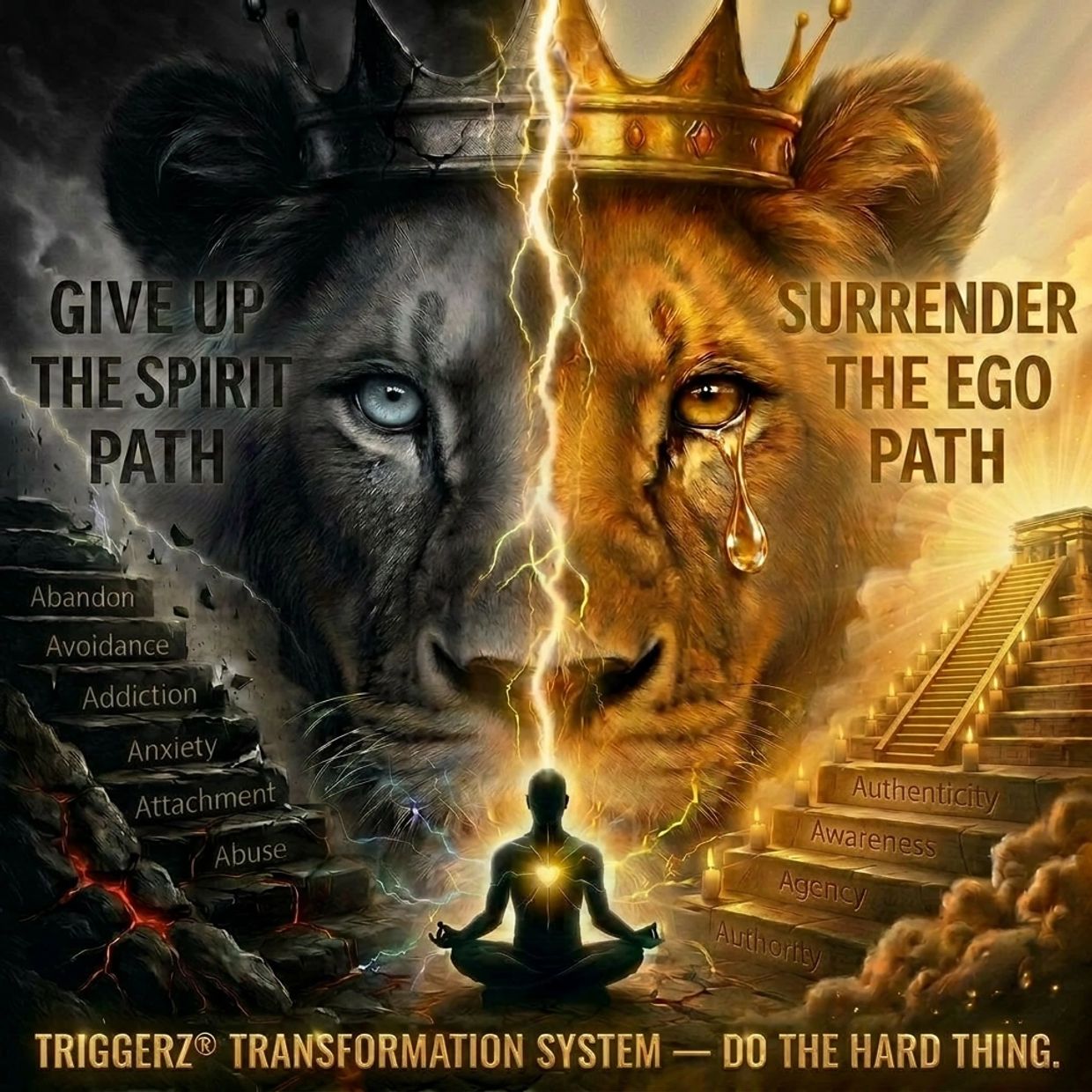
- The path of giving up the spirit, where we keep protecting the wound and identifying with the lies, or
- The path of surrendering the ego, allowing the wounds under the cast to be healed so our spirit can lead.
If we keep choosing the path of giving up the spirit, pain is designed to surmount. Over time it builds toward a rock bottom, a point where the pain of staying the same finally becomes greater than the fear of the unknown. That rock bottom is the turning point: when it feels like there is no other direction, many people finally become willing to surrender the ego and open to healing.
Through TRIGGERZ®, healing the wound under the cast becomes the central task. While we do have agency over our actions, our behaviors are ultimately created from our feelings and energy baseline, which in turn is derived from what we believe about ourselves. When we try to force “good” behaviors that are out of alignment with how we actually feel at a baseline level, those behaviors become masks – disingenuous expressions that look right on the outside but are not true on the inside.
Authenticity matters because energy leads behavior. The highest frequency we can live from is authenticity and enlightenment, not performance. Free will does not mean endlessly faking different behavior; it means choosing which path we walk at the level of belief and surrender. When our beliefs about ourselves shift and our baseline energy comes into alignment with who we are in spirit, our behaviors naturally follow. Actions that flow from that aligned baseline are not forced or fake; they are the outward expression of an inner truth that has been healed. Healing means bringing the lie and its pain fully into awareness and the body, then moving it through processes of feeling, forgiving, releasing, loving, and feeling gratitude for what it revealed. As the wound heals, there is nothing left for the cast to protect. The ego no longer needs to stay wrapped tightly around that area, so the “cast” can naturally fall away. More of the spirit is exposed and active than the cast or ego.
A helpful way to picture this is the cup story. Over years, your “cup” has held both truth about your worth, safety, and belonging, and “poison” in the form of lies, shame, and fear‑based conclusions. Every unhealed wound and protective pattern adds more poison. Healing is like pure water being poured into the cup. Slowly, the ratio changes. The poison is diluted, and what you are drinking from and pouring out becomes clearer. As you keep living in truth, your cup begins to overflow. You only need one cup to feel hydrated, filled, and loved, yet now you have more. From that place, you can offer presence, regulation, forgiveness, and honesty to others without draining yourself.
We are not designed to do this work alone. We are here to trigger and co‑regulate one another in ways that reveal what is ready to be healed. Sometimes you will be cast in someone else’s story as the “source” of their hurt, not because you are bad, but because their system is ready to see where they have abandoned themselves. Sometimes others will mirror that work for you. In this pillar, TRIGGERZ® frames these moments not as accidents or punishments, but as invitations. A trigger becomes a signal that a wound under the cast is ready for care and truth.
As more wounds are healed, our baseline energy shifts. As our baseline rises, our inner world becomes less compatible with the heaviness and density of old patterns. Over time, there comes a point where the level of truth, coherence, and love we are living from no longer resonates with the conditions that once matched our pain. Spiritually, this is a kind of graduation: our essence outgrows the frequency of a previous chapter, body, or even lifetime, and moves into the next stage of evolution that can hold what we have become.
We still feel the full range of human emotion, but we relate to it from a more regulated, grounded place. The ego can return to its proper role as a light protector rather than a constant guard. The shadow becomes information rather than something to fear. Our inner masculine and feminine energies – structure and softness, doing and being – have room to rebalance, and our behavior is created less by survival and more by alignment.
In the end, Pillar 7 is about knowing who we are and why we are here. We are here to reveal and transform lies into truth, to move from dysregulation to coherence, and to participate with God in raising our capacity for love, forgiveness, and presence. As we do, who we truly are – our essence flame from the sun – shines more clearly through everything we say, do, build, and become.
Pillar 8 – Theory of the Three Core Belief Wounds
The three core belief wounds are:
- I am not worthy.
- I am not loved.
- I do not love myself.
Every lie believed about yourself, others, or life, when peeled back to its deepest layers, lands in one or more of these three wounds in some form, fashion, or onion layer. A thousand different stories about rejection, failure, abandonment, comparison, shame, or not belonging are different ways these same core wounds express themselves.
In this pillar, every triggered belief is treated as a doorway to ask:
“Where is ‘I am not worthy’ hiding in this?”
“Where is ‘I am not loved’ being assumed here?”
“Where is ‘I do not love myself’ showing up in how I treat me?”
As those specific forms are recognized, you can work them through the TRIGGERZ® process, feeling the emotion, using Flip the Script and Hand of God, and allowing the belief to be transformed so your baseline gradually shifts from these core lies into lived experiences of worthiness, love, and self-honor.
Pillar 9 – Theory of Safety Within
True safety is cultivated inside. When your nervous system and spirit know you are safe, you no longer have to control everything outside of you to feel okay.
Safety within is built by reducing external noise and replacing it with expanding practices and habits that your body can rely on. As you choose a practice, decide fully how and when you will do it, and follow through consistently, your body begins to trust the reliability of that rhythm. Over time, your system learns “this is what we do” and starts to relax into the predictability.
A key piece of this pillar is closing loops. Psychologists have described the Zeigarnik effect, first observed by Bluma Zeigarnik, in which unfinished tasks and unresolved decisions create mental tension and keep the brain on alert until they are completed or closed. More recent writing on productivity and mental health has extended this idea to show how open loops drain attention and increase background stress. Research on intolerance of uncertainty in anxiety disorders, including work by researchers such as Tanovic, Gee, and Joormann, shows that not knowing outcomes and leaving things open increases anxiety and threat responding in the nervous system, especially in people who find uncertainty hard to tolerate.
By regularly scanning for open loops in your day, such as unmade decisions, unsent messages, or half started tasks, and closing them with a clear choice or next step, you reduce the background noise your nervous system is tracking. Each closure sends a small signal of safety and completion.
The power of a full decision matters here. Studies on anxiety and decision making, summarized in publications from the American Psychological Association and other neuroscience reviews, suggest that high anxiety keeps the brain stuck in simulation mode, revisiting options and imagining negative outcomes, which weakens the prefrontal cortex’s ability to commit to a course of action and regulate the amygdala’s threat signals. A half decision keeps your system in that loop. A full decision gives your nervous system a stopping point so the question is settled, at least for now, and your body can stand down.
As you become a reliable source of regulation for yourself, by choosing grounding practices, closing loops, and making full decisions, your body begins to trust you. The more you trust yourself, the less you need external validation to feel safe, and the easier it becomes to live from an internal sense of stability instead of constant vigilance.
Pillar 10 – Theory of Nervous System Entanglements
Your nervous system carries patterns from past experiences and relationships. Clinical work on relational and attachment trauma shows that old wounds and memories can shape present-day reactions, so a small comment now can trigger a response that actually belongs to an earlier experience. When those patterns are not seen and felt through, your body can respond to the present as if it is still in the past.
Modern science shows that our systems are not isolated.
- Close relationships create biological bonding: hormones like oxytocin, often called the "bonding hormone," increase trust and sensitivity to social cues, and are linked to how we attune to people we are connected to. Research from Harvard Medical School and other neuroscience groups has explored how oxytocin influences emotional bonding and responsiveness in close relationships.
- Work on interpersonal neural synchrony has found that brain activity can become synchronized between partners and between parents and children during interaction, especially in frontal and temporal regions that process emotion, attention, and social connection. A 2017 study published in Scientific Reports and related research highlighted in Spectroscopy Online showed that brains can synchronize in real time during meaningful interactions.
- Research on mirror neurons and emotional contagion shows that specific neural networks fire both when we act and when we see someone else act, and that this mirroring can extend to emotions, so our nervous system can begin to feel what another person is feeling without us consciously choosing it. Neuroscience articles from UCLA Health, InMind Services, and Dr. Carrie Rigoni have explored how mirror neurons support empathy and emotional contagion, influencing how we resonate with the states of those around us.
In close proximity and connection, nervous systems can "entangle" in this way. We bond, oxytocin is released, mirror neurons fire, and our bodies start to resonate with each other. Sometimes our nervous system reacts as if it is the other person's, echoing their fear, shame, or defense even when we did not consciously decide to go there.
Within TRIGGERZ®, this pillar holds a deeper possibility. If we are here to expose and transform the lies we are subconsciously believing, and if other people often serve as mirrors for us, then some of the most intense moments in relationships may be soul level collaborations. On a subconscious and spirit led level, we may feel another person's nervous system and, without intending harm, our words or actions touch the exact point of their pain or insecurity.
From the outside it can look like "you caused my hurt." From this pillar's perspective, the interaction did not create the wound; it revealed a wound that was already there and ready to come to the surface. The trigger becomes an invitation for both people:
- For the one who feels hurt, to see the lie beneath the pain and move it through Flip the Script and Hand of God.
- For the one whose words or actions touched the wound, to recognize the entanglement with compassion and to take responsibility for their own state, rather than collapsing into shame.
As nervous system entanglements are brought into awareness and felt through, you become more able to notice, "This surge I am feeling might not be mine," to ground your own system, and to respond to the present moment rather than replaying past patterns.
Pillar 11 – Theory of Conflict Repair and Communication
Through this pillar, we learn and practice the ideal conflict repair process and communication tools for optimal nervous system regulation and emotional processing.
Male and Female Brains Are Designed Differently
Research in neuroscience shows consistent patterns of difference in how male and female brains are structured and how they process emotion and communication.
Studies from Stanford Medicine, the University of Pennsylvania, and others have found that in male brains, verbal centers are located primarily in the left hemisphere, while emotional processing centers are more active in the right hemisphere, with fewer neural bridges connecting the two. This can explain why many men find it harder to talk about their feelings in real time, not because they don't have them, but because the centers that process emotion and the centers that produce speech are farther apart and less densely connected.
In contrast, research shows that female brains have verbal centers on both sides and exhibit stronger cross-hemispheric connectivity, particularly between analytical and emotional processing areas. This helps explain why many women naturally talk through their emotions as they feel them and process them verbally to regulate.
Work from the University of Pennsylvania's brain connectivity studies also found that male brains show greater connectivity from front to back and within hemispheres, supporting coordination between perception and action, while female brains show more between-hemisphere connectivity, facilitating the integration of analytical and intuitive modes.
Nervous System Design and Threat Response
From an evolutionary and biological perspective, these patterns serve different protective functions. The male nervous system is oriented toward external threat detection and neutralization, which is why men regulate through action and doing. Once the threat is stabilized, the system compartmentalizes, the body regulates, and he moves forward.
The female nervous system is oriented toward connection and relational safety, which is why women regulate through verbal processing, emotional expression, and the re-establishment of connection. Her nervous system does not fully settle until connection is restored and oxytocin signals that safety has returned.
Put simply, this biology helps explain the ideal energetic pattern to be recognized: the masculine initiates, and the feminine receives, multiplies, and reciprocates. The masculine energy is oriented toward moving first, taking action, creating direction, and offering protection. The feminine energy is oriented toward receiving that initiation, amplifying it through connection, emotion, and creativity, and then returning it as multiplied care, insight, and resonance. This flow can live in any body, but when it is honored in a relationship, both nervous systems tend to feel more authentic and regulated.
In the TRIGGERZ® conflict repair process, this shows up as the masculine energy initiating repair and the feminine energy receiving, processing, and then reciprocating. When the masculine initiates with a grounded, protective presence, the feminine nervous system reads, “I am safe and pursued,” which calms threat detection and opens space for emotional expression. She can then process, feel, and bring back multiplied clarity, insight, and softness into the connection. This honors the biological design of men to regulate through decisive action and many women to regulate through felt connection and expressed emotion, while still allowing both to access masculine and feminine strengths as needed.
Understanding biological design explains why conflict repair works best when both systems are honored.
Regulation happens separately first, allowing each person's system to settle into its design, and then the connection is intentionally restored.
The Ideal Conflict Repair Process
- Regulate separately for up to 20 minutes using nervous system tools from the TRIGGERZ® process. This gives the body time to metabolize stress hormones and allows the prefrontal cortex to come back online.
- Masculine energy initiates reconnection. The masculine steps into a protective, grounded presence and signals safety by initiating repair. This allows the feminine nervous system to relax more fully than if she had to pursue connection herself.
- Use TRIGGERZ® communication tools to repair with integrity:
- Regulation: "I need to take a break to regulate. Can we talk at 7pm?" Honor the 90-second emotional wave and give yourself space to move out of amygdala hijack. Giving a specific time to resolve the conflict and initiate connection closes a loop of an unknown and creates safety.
- Talk to Listen: "Help me understand your perspective" and mirror back what you heard. Research on neural coupling and brain-to-brain synchrony shows that active listening can synchronize nervous systems and create safety.
- Take Accountability: "I can see how my behavior contributed to this." This activates mirror neurons and engages the prefrontal cortex's capacity for self-awareness and metacognition.
- Express Needs Without Control: "I notice I'm feeling [emotion]. To feel [need], what can we do together?" This invites collaboration, releases the need to control outcomes, and honors both people's agency.
- Create Safety: Use proactive transparency, such as "I want to share something with you...", to reduce threat detection, build predictability, and activate the vagus nerve's calming pathways.
- Integration: Approach with curiosity over defensiveness: "I'm curious what's happening between us." This shifts the brain from threat mode to discovery mode and activates reward pathways.
4. Practice diffusion language, "I" statements, curiosity-based inquiry, softened startups, and non-defensive mirroring to stay regulated and communicate from overflow rather than need.
Check Your Intention: Overflow vs. Need
Before using any communication tool, check whether you are giving from overflow (fullness, genuine care, no attachment to outcome) or from need (trying to get them to apologize, validate you, or change).
Your partner will feel the energetic difference, even if your words are perfect.
Overflow means you are offering these tools because they reflect who you are becoming and who you have always been underneath the wounds. Need means you are performing them to control the outcome. As you do your own TRIGGERZ® healing work, these tools will flow naturally from integrity, not manipulation.
The Complete Repair Sequence
- Step 1: Masculine initiates: "I want to repair what happened between us. Can we talk?"
- Step 2: Masculine acknowledges impact: "I can see that what I said hurt you."
- Step 3: Masculine takes ownership of their trigger and commits to healing: "I felt triggered in that moment, and I take full ownership of my reaction. I'm committed to looking at which lie I was believing and doing the work to heal it."
- Step 4: Masculine asks for forgiveness and asks the feminine to walk through what the situation felt like for her; seeking to understand and how to provide safety for her nervous system to resume regulation.
- Step 5: Feminine offers forgiveness, and her nervous system begins to relax.
- Step 6: Feminine shares how she felt through the situation, and through this communication being received in a safe space with the masculine's full presence (not wanting to fix, get defensive, gaslight, or stonewall - just the full masculine presence energy), her nervous system is regulating in real-time. She then acknowledges impact, mirrors back her understanding of how her partner felt, and reciprocates steps 2 through 4. The masculine offers forgiveness, and the connection is repaired.
- Step 7: Both commit to doing their own inner work and supporting each other's healing.
This process honors the design of both nervous systems, creates safety through predictability and initiation, and transforms conflict into an opportunity for deeper connection and individual growth.
Pillar 12 – Theory of Creating Another Person
Your beliefs, projections, and agreements “create” versions of other people in your mind. Shifting your lens changes how you experience them.
In psychology, projection describes how we place our own unhealed beliefs and fears onto others and then react to them as if they were facts about that person. In relationships, this means we often experience partners, children, and leaders not as they truly are, but as a mix of who they are and what we unconsciously believe about ourselves and the world.
Neuroscience helps explain why this has real impact. Research on mirror neurons and emotional contagion shows that when we are with someone, our nervous systems constantly read and reflect each other’s states. The tone, body language, and energy you hold around someone are felt by their system as real input. Over time, what you consistently believe and expect becomes part of the environment in which their identity grows.
The Michelangelo phenomenon is a research‑based name for this sculpting effect in close relationships. Work by Stephen Drigotas and colleagues, and later by Caryl Rusbult, Eli Finkel, and Madoka Kumashiro, found that when a close partner sees you and interacts with you in ways that align with your own ideal, authentic self, you are more likely to grow in that direction. In healthy relationships, the way we see and respond to each other can “chip away” what is not truly us and draw forward who we were always meant to be.
This cuts both ways:
- When you repeatedly hold someone in a story like “you are lazy,” “you always fail,” or “you can’t be trusted,” and they absorb that energy without challenging it, your lie can become their lie. Their baseline energy adjusts to fit that belief, and their behaviors naturally organize around it.
- When you genuinely and authentically see and believe in someone’s God‑given essence and potential, beyond their current wound or behavior, your consistent, authentic belief becomes a stabilizing field they can grow inside of. Their baseline energy slowly rises to meet the truth you are quietly reflecting.
There are two safeguards: authenticity and honoring what is currently believed.
Because our brains carry a negativity bias for survival, people naturally resonate truth more with the pain they already feel than with a new positive story. If you skip over someone’s real experience and insist on a positive spin, it lands as gaslighting. Their body tightens, defenses rise, and trust fractures, because their nervous system reads, “You are not seeing me.”
In TRIGGERZ®, the sequence is:
- Honor the current belief and feeling as true for that person right now. Genuinely let their experience be fully seen, named, and felt.
- Offer your belief as genuine overflow, not pressure. You naturally hold and embody the truth you see about them without needing them to agree or change on the spot.
- Allow their system to receive at its own pace. Because the belief is real in you and not manufactured, the energy of it still lands, even when it is not fully accepted in words yet.
As you do your own work with Flip the Script and Hand of God, you uncover and transform the lies you have believed about yourself. The more you truly believe in your own worth and identity, the more you can authentically see and believe into others. Your nervous system becomes a channel of regulated, grounded belief rather than projection and fear. Over time, the people around you feel that in their bodies; their baseline energy, behaviors, and reality begin to reorganize in response to the truth you consistently hold and live from.
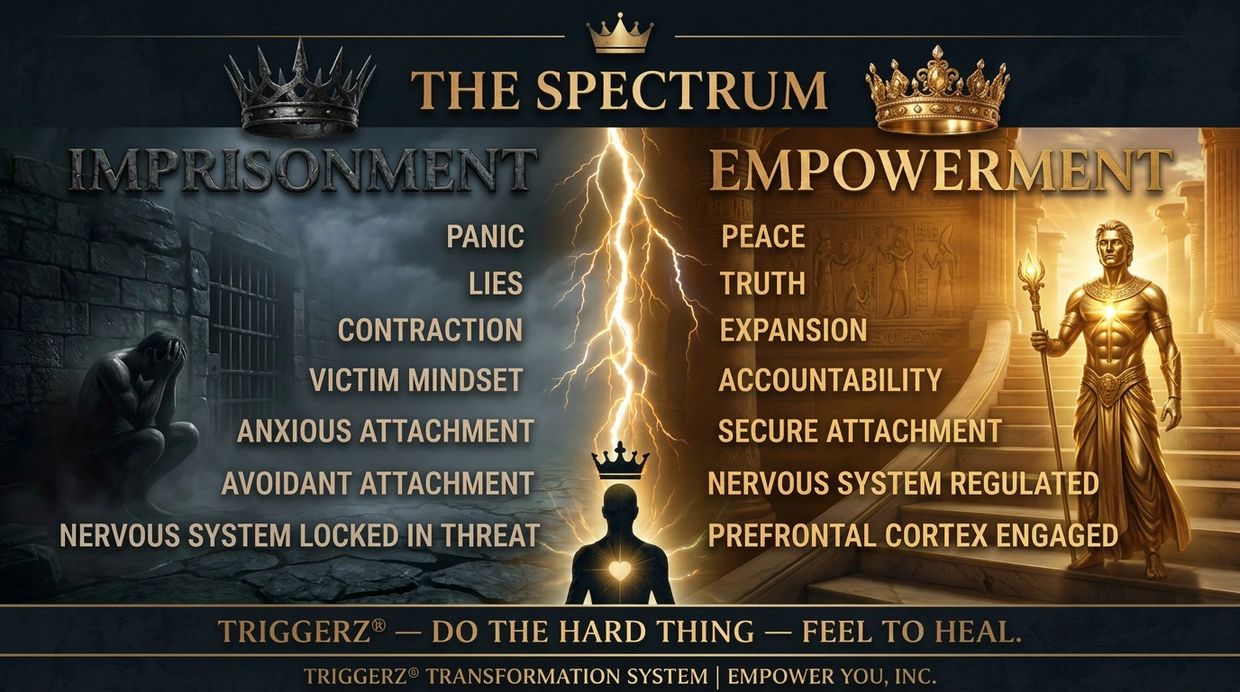
Pillar 13 – The Spectrum: Imprisonment → Empowerment
Every moment sits somewhere on the spectrum between imprisonment and empowerment. TRIGGERZ® exists to move you toward freedom, responsibility, regulation, and sovereign choice.
On one end of the spectrum is imprisonment. Imprisonment is synonymous with lies, falsehood, untruth, darkness, panic, and the beliefs we carry about ourselves that keep us stuck in survival. It includes emotions below the line of courage on the Map of Consciousness, contracting behaviors, an assumption and judgment lens, and a victim mindset. In this state, the nervous system is more likely to stay locked in threat, the mind narrows, and the body organizes around protection rather than truth. Research on the amygdala and emotional processing shows that when threat is high, brain and body systems prioritize survival and defensive responding over reflection, flexibility, and integration, as described in work published in Understanding Emotions: Origins and Roles of the Amygdala and Multiple Mechanisms of Consciousness: The Neural Correlates of Consciousness.
On the other end of the spectrum is empowerment. Empowerment is synonymous with truth, light, accuracy, authenticity, enlightenment, God, alignment, peace, and emotional states above the line of courage. It includes expanding behaviors, a curiosity and intrigue lens, and an accountability mindset. In this state, the nervous system is more regulated, the body experiences greater safety, and the prefrontal cortex is more available for perspective, discernment, and conscious choice. Research on emotional literacy, consciousness, and regulation in Frontiers and related neuroscience work shows that higher-regulation states are associated with greater self-awareness, integration, and adaptive functioning.
This spectrum also includes attachment styles. On the imprisonment side, anxious attachment often shows up through fear of abandonment, hypervigilance, and emotional urgency, while avoidant attachment shows up through distancing, shutting down, emotional suppression, and self-protective withdrawal. Secure attachment aligns more closely with the empowerment side of the spectrum through openness, trust, regulation, honesty, and the capacity to stay connected without losing the self. Attachment research consistently shows that insecure patterns are associated with greater threat sensitivity and defensive responses, while secure attachment supports co-regulation, resilience, and healthier emotional functioning.
There is an entire living spectrum between panic and peace, lies and truth, contraction and expansion, victimhood and accountability. We move along this spectrum constantly. Our baseline energy state adjusts over time according to the states we rehearse most often. Research on anxiety, uncertainty, and regulation shows that repeated activation of threat pathways strengthens defensive patterns, while repeated experiences of regulation and safety strengthen the neural pathways associated with calm, flexibility, and self-regulation.
In TRIGGERZ®, this pillar names a simple truth. Panic (indicates that a lie is being believed) lives toward the imprisonment end of the spectrum. Peace (which indicates that a truth is being believed) lives toward the empowerment end. The more we intentionally and habitually embody the TRIGGERZ® process, and the more we use tools like Flip the Script and Hand of God to feel emotion fully, transform lies into truth, and regulate the nervous system, the more our baseline energy shifts toward empowerment. Work on emotions as embodied patterns of energy and information, including research on emotional literacy and psychophysiology, supports the idea that emotional states shape perception, behavior, and capacity for action over time.
This pillar is not about pretending to always live at the empowerment end. It is about recognizing where you are on the spectrum in any given moment, honoring it honestly, and then moving yourself one step at a time toward truth, alignment, peace, and the empowered identity you were created to live from.
11 eLEMENT SEQUENCE, EXPANDED
Surrender – Quiet the noise.
Surrender – Quiet the noise.
Surrender – Quiet the noise.
We begin by surrendering the ego’s constant grip and doing inventory on what is filling our world: phones, media, relationships, commitments, and distractions. We ask God which noise our body is ready to release right now. By letting some of that go, we create the space needed for healing to even begin.
Stabilize – Calm the body.
Surrender – Quiet the noise.
Surrender – Quiet the noise.
Next, we stabilize through proactive nervous system regulation practices. As the body begins to feel safer, emotions start to rise. Many people think something is wrong with them when they feel “more,” but the opposite is true: it is often a sign that the system is regulating and emotions finally feel safe enough to come to the surface.
Spirit – Connect with God.
Surrender – Quiet the noise.
Surface – Let feelings rise.
With more space and regulation, we turn toward God. We ask, “What do I need to see, know, feel, or experience right now?” Instead of running first to another person, device, or quick answer, we practice returning to God as the primary source of wisdom and guidance.
Surface – Let feelings rise.
See – Use Flip the Script & Hand of God.
Surface – Let feelings rise.
We allow the feelings that are ready to come up to surface. Rather than pushing them away, we acknowledge them and give them permission to be felt.
Sit – Stay with the feeling.
See – Use Flip the Script & Hand of God.
See – Use Flip the Script & Hand of God.
We stay with the emotion long enough for it to complete its natural arc. Instead of distracting or shutting down, we remain present so the feeling can fully “eclipse” and pass through.
See – Use Flip the Script & Hand of God.
See – Use Flip the Script & Hand of God.
See – Use Flip the Script & Hand of God.
Here, we move into the core TRIGGERZ® tools. Through Flip the Script and Hand of God, we explore alternate beliefs and feel, somatically, the difference between panic and peace, lie and truth. We are not just thinking new thoughts; we are letting the body experience both and notice the contrast.
Shift – Feel the new belief.
Sovereign – Stand in your identity.
Sovereign – Stand in your identity.
We embody the new, true belief and feel it fully and completely in the body. This is where the inner narrative begins to change at the level of sensation and energy, not just words.
Sovereign – Stand in your identity.
Sovereign – Stand in your identity.
Sovereign – Stand in your identity.
As the truth is felt somatically, we experience a sense of sovereignty – remembering and inhabiting who we actually are in spirit. We feel more like the one who chooses, rather than the one who is constantly at the mercy of triggers.
Sense – Feel the new baseline.
Sovereign – Stand in your identity.
Sense – Feel the new baseline.
We take time to notice how our baseline energy has shifted. We sense what it feels like, internally, to live from this more regulated, truthful place instead of the old, wounded one.
Shape – Let behavior follow.
Soar – Live the transformed reality.
Sense – Feel the new baseline.
From this adjusted baseline, behavior begins to change naturally. Instead of forcing “good” behavior that does not match how we truly feel, we let action flow from the new state. Choices, boundaries, and habits start to reflect the healed belief and calmer nervous system.
Soar – Live the transformed reality.
Soar – Live the transformed reality.
Soar – Live the transformed reality.
Over time, reality reorganizes to mirror the new baseline and in response to the authentic behaviors that flow from it. We still experience the full range of human emotion, but we move through life from a more coherent, aligned place. This is “soaring” – not perfection or constant bliss, but living as a regulated, truthful, sovereign self in everyday life.
THE SCIENCE BEHIND FEELING
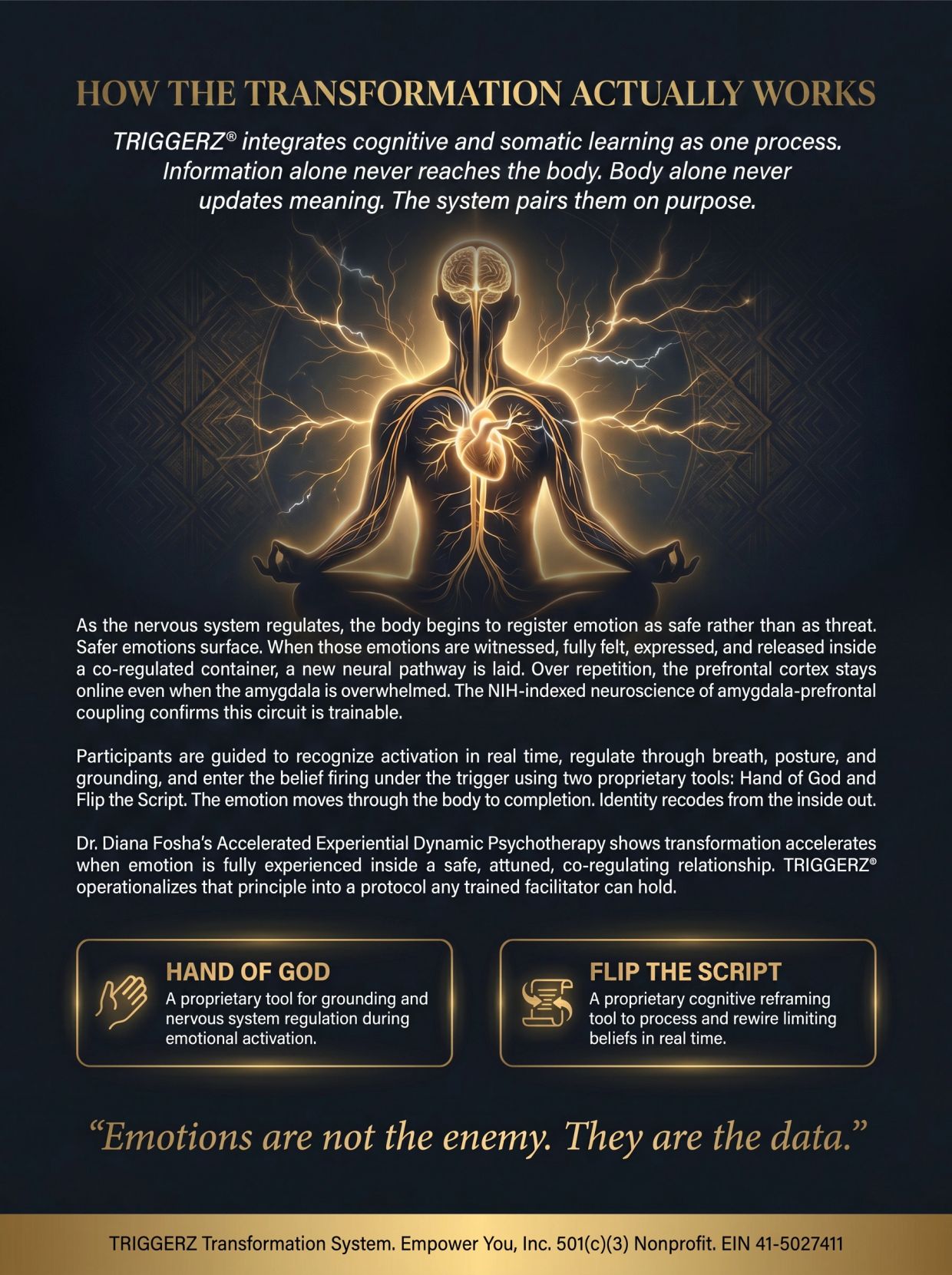
TRIGGERZ® is built on a simple but powerful principle: real transformation does not happen only by thinking differently. It happens when emotion is safely felt, fully processed, and integrated in the body, the nervous system, and the mind. Research in experiential and affective psychotherapy shows that lasting change is more likely when emotional experience is engaged directly rather than avoided, bypassed, or managed only at the level of thought.
WHY FEELING MATTERS
When emotional responses are chronically suppressed, over‑intellectualized, or overridden by control strategies, physiological systems tend to remain organized around protection and threat readiness rather than recovery. In contrast, when emotions are accessed, tolerated, and processed within a context of sufficient safety, the organism is more able to complete the associated stress responses and return toward a regulated baseline. From a clinical and neurobiological perspective, healing is therefore not limited to verbal discussion of feelings. It involves facilitating experiential and somatic processing that allows entrenched emotional patterns to update, supporting new neural organization and more flexible regulatory capacities.
DIANA FOSHA & EXPERIENTIAL CHANGE
Psychologist Diana Fosha is known for Accelerated Experiential Dynamic Psychotherapy, or AEDP, an approach built around the idea that transformation accelerates when emotion is fully experienced in the presence of a safe, attuned, co‑regulating relationship. Her work on the dyadic regulation of affect emphasizes that emotional healing is not just inside the head, but also relational: the nervous system changes more effectively when intense emotion is felt while the person remains connected, supported, and emotionally accompanied.
This helps explain why insight alone is often not enough. A person may understand their patterns intellectually and still remain stuck. Fosha’s work suggests that neural and emotional change are more likely when feelings are experienced directly, processed to completion, and transformed within a relational context that supports safety, openness, and regulation.
JILL BOLTE & THE EMOTIONAL WAVE
Neuroscience educator Jill Bolte Taylor is widely known for teaching that the physiological life cycle of an emotion in the body is about 90 seconds unless it is reactivated by thought. That specific number is best seen as a simplified educational model rather than a fixed rule for every emotional experience, but the broader principle is consistent with neuroscience: emotional responses involve a rapid physiological wave, and the brain can keep that wave going when we repeatedly feed it through rumination, interpretation, or threat‑focused thinking.
In practice this means that emotions often move through the system more efficiently when they are noticed, felt, and allowed, instead of resisted or constantly re‑triggered. When emotions are suppressed or repeatedly amplified cognitively, the stress response can stay active longer. The goal is not endless emotional intensity; the goal is completion, allowing the body and nervous system to move through the wave instead of trapping it in a loop.
WHAT HAPPENS IN THE HEART, BRAIN, & NERVOUS SYSTEM
Effectively processing emotion is associated with changes across multiple physiological and neural systems.
- Brain: When emotions are attended to and processed rather than chronically suppressed, activity can shift from predominantly limbic and threat‑driven reactivity toward more integrated patterns involving cortical regions that support awareness, reflection, and regulation. This reflects a move from automatic survival responses toward greater top‑down modulation of emotional experience.
- Autonomic nervous system: Emotional processing that occurs in a context of safety and co‑regulation can help the autonomic nervous system transition out of states of hyperarousal or shutdown and back toward a more balanced range of sympathetic and parasympathetic activation. In practical terms, this looks like reductions in physiological markers of acute stress over time, alongside improved capacity to tolerate and recover from emotional load.
- Cardiovascular and systemic physiology: Experimental work on crying and sadness has shown that, following an emotional peak, some individuals display patterns consistent with post‑stress recovery, such as changes in heart rate and other physiological indices, although results vary by study and are strongly influenced by context and individual differences.
Taken together, the evidence supports a careful conclusion: when emotion is acknowledged, experienced, and processed within a sufficiently safe environment, the organism is generally better positioned to move back toward physiological and psychological coherence than when emotion is chronically suppressed, invalidated, or avoided.
THE SCIENCE OF EMOTIONAL TEARS
Humans produce three main tear types: basal tears for continuous lubrication, reflex tears in response to irritants, and emotional tears in response to affective states such as sadness, relief, or awe. All tears contain water, electrolytes, proteins, lipids, and mucins, but emotional tears show distinct biochemical and functional features.
Analyses indicate that emotional tears can contain higher concentrations of hormones and neuropeptides associated with stress and emotional processing, including prolactin, adrenocorticotropic hormone (ACTH), and endogenous opioids such as leucine enkephalin, alongside distinct metabolite profiles compared with basal and reflex tears. Functionally, emotional crying engages limbic and autonomic networks and is associated with an initial phase of heightened arousal followed by markers of parasympathetic recovery and post‑cry regulation. Context is critical: studies suggest that crying is more likely to be followed by relief and physiological recovery when it occurs in a supportive environment rather than under conditions of shame or ongoing threat.
Emotional tears also operate as social signals that increase the likelihood of caregiving, empathy, and co‑regulation from observers, which further supports nervous‑system stabilization. From this perspective, emotional tears are not incidental. They represent one pathway through which the body, brain, and relational field participate together in stress modulation and emotional integration.
.png/:/rs=w:1240,cg:true,m)
what you can expect: evidence-informed results
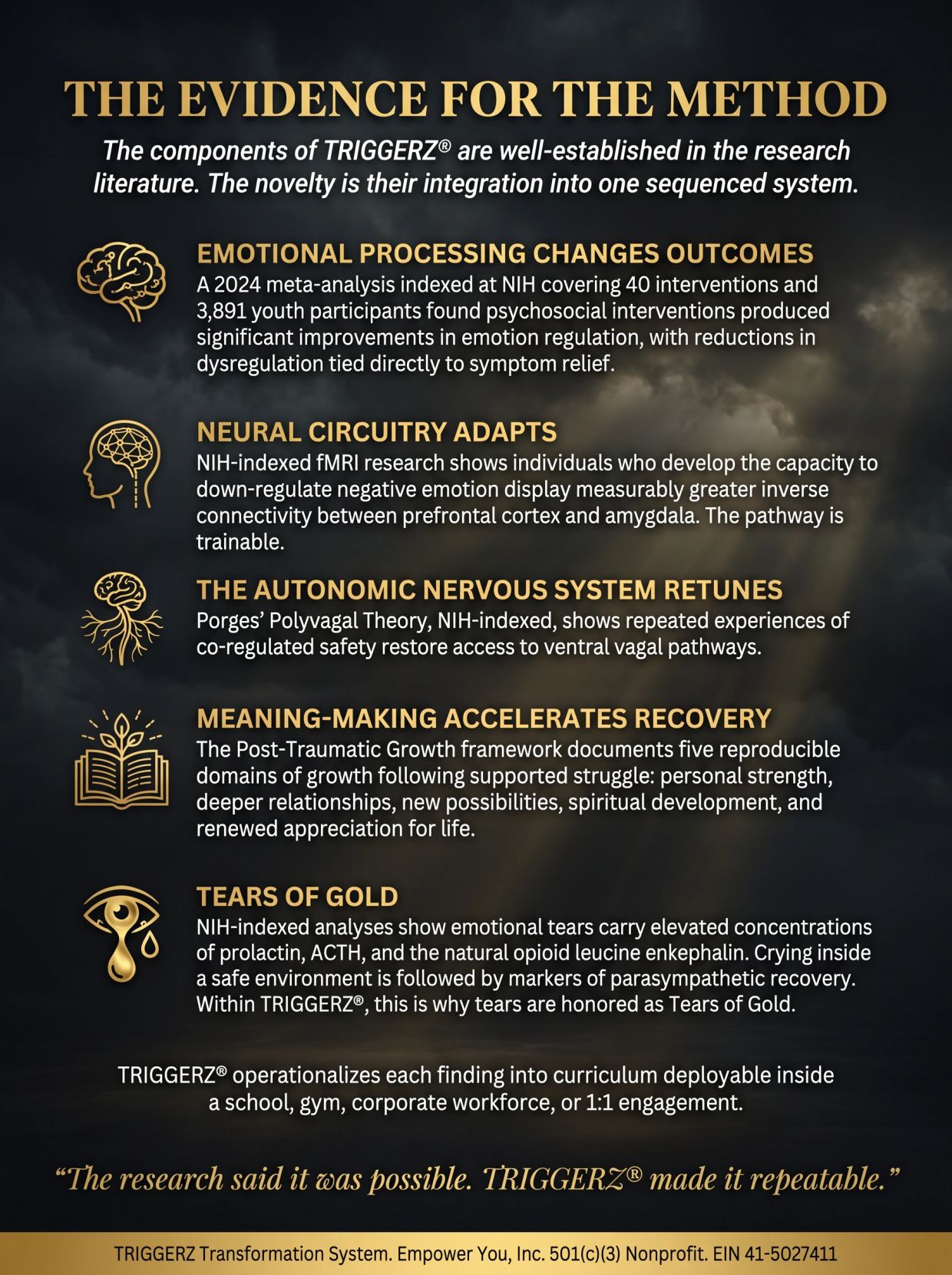
TRIGGERZ® has been in development since 2021 and is now being launched, built from components that have already been shown to work in clinical and neuroscience research: deep emotional processing, nervous system regulation, spiritual meaning‑making, and safe co‑regulated relationships.
Emotional Processing
Studies of emotion‑focused and experiential therapies show that helping people fully feel and work through core emotions can significantly reduce anxiety and depression, with outcomes comparable to or sometimes stronger than purely cognitive approaches. Brain‑imaging research on emotion regulation finds that when people engage with emotion and then use adaptive strategies, activity shifts from limbic “threat” regions toward prefrontal areas involved in regulation, and distress usually drops. Together, this supports the expectation that TRIGGERZ® can help lower emotional distress and increase flexibility with feelings over time.
Nervous System & Baseline
Emotion‑regulation studies using EEG and fMRI show that effective regulation is tied to distinct patterns of brain activation and better control of physiological responses. Models that combine body awareness with top‑down regulation are associated with better outcomes than suppression or avoidance. Because TRIGGERZ® continually brings the autonomic nervous system back from hyperarousal or shutdown, it is reasonable to expect faster recovery after triggers, more time in a regulated “window,” and a gradual lift in baseline energy toward calm and coherence.
Beliefs, Meaning, & Spirituality
Large practice‑based studies of spiritually integrated psychotherapy, including work with more than a thousand clients, show that when spiritual struggles and questions of meaning are addressed directly for people who want that, psychological distress tends to fall substantially within weeks. Other spiritually informed models have produced greater reductions in depression, anxiety, and stress than education‑only approaches. This supports using a spiritually anchored framework like TRIGGERZ® to reduce both psychological and spiritual distress and increase a sense of alignment.
Co-Regulation & Relationship
Research on dyadic regulation of affect and experiential therapies (such as Diana Fosha’s AEDP) indicates that processing emotion in a safe, attuned relationship deepens and accelerates change. Across many therapy approaches, the quality of the relationship consistently predicts outcome as strongly or more strongly than specific techniques. TRIGGERZ® leans into this by treating co‑regulation and attuned presence as essential, not optional.
Emotional Tears
Biochemical work shows that emotional tears differ from basal and reflex tears, containing higher levels of stress‑related hormones and neuropeptides like prolactin, ACTH, and leucine enkephalin, as well as distinct metabolite profiles. Reviews of human crying report that, after sadness‑related crying, many people show physiological signs consistent with stress recovery, especially when they cry in safe, supportive contexts. Tears also act as social signals that increase empathy and caregiving responses from others. Within TRIGGERZ®, this justifies treating emotional tears as “tears of gold”: part of how stress chemistry and unmet emotional needs move into a space where they can be seen and healed.
© Empower You, Inc. All rights reserved. TRIGGERZ® and all content on www.empoweryourtriggerz.org are for educational and spiritual purposes only and do not constitute medical, psychological, or other professional advice, diagnosis, or treatment. The founder and facilitators are not licensed therapists or medical doctors. Use of this site and participation in any programs are voluntary and do not create a therapist–client or doctor–patient relationship. Always consult a qualified healthcare or mental health professional about your health and well‑being. By using this site, you accept full responsibility for your own decisions and release Empower You, Inc. and its representatives from liability related to your use of this information.
Copyright © 2026 empoweryourtriggerz.org - All Rights Reserved.
This website uses cookies.
We use cookies to analyze website traffic and optimize your website experience. By accepting our use of cookies, your data will be aggregated with all other user data.